
Visual summary
See the whole article at a glance
Follow the journey, then explore how the key ideas connect.
Article journey
Topic mind map
- Why Omnichannel HCP Engagement Is No Longer Optional in KSA
- The Omnichannel Framework: Five Pillars
- Building Your Program: Where to Start
Questions answered (5)
Why Omnichannel HCP Engagement Is No Longer Optional in KSA?
Saudi Arabia's healthcare landscape is undergoing its most significant transformation in a generation. Vision 2030 has catalyzed a rapid expansion of hospital capacity, a push toward preventive care, and an increasingly empowered community of healthcare professionals. For pharma and medtech companies operating in the Kingdom, one truth has become undeniable: the days of single-channel detailing are over.
Healthcare professionals in KSA today expect interactions that are relevant, timely, and consistent — whether they encounter your brand at a congress booth in Riyadh, through a peer-reviewed digital content module, or via a one-on-one medical science liaison visit. Omnichannel engagement is not a buzzword; it is the operating model that separates brands with growing prescription share from those quietly losing ground.
This article outlines a practical framework for building omnichannel HCP engagement programs in Saudi Arabia, with attention to the regulatory, cultural, and structural realities that make the Kingdom a unique market.
Understanding the KSA HCP Landscape?
Before designing any engagement model, brands must understand who they are engaging. Saudi Arabia has more than 85,000 licensed physicians and an estimated 300,000 total licensed health professionals, with significant concentrations in Riyadh, Jeddah, and the Eastern Province. A growing proportion are Saudi nationals trained locally or internationally, often highly digitally fluent and peer-connected through platforms like LinkedIn, WhatsApp professional networks, and specialty society channels.
Key structural factors shaping HCP engagement in KSA include:
Sector segmentation: The Ministry of Health (MOH) manages the largest hospital network, but the private sector — led by groups like Saudi German Hospitals, Dr. Sulaiman Al-Habib, and Mouwasat — is growing rapidly. Engagement strategies must be differentiated by sector, as access protocols, influence dynamics, and procurement timelines differ substantially.
Formulary gatekeeping: For hospital-based prescribers, formulary committee decisions drive adoption more than individual HCP preference alone. Engagement programs that ignore this layer will underperform regardless of HCP sentiment.
Regional KOL influence: Saudi medical societies — Saudi Cardiology Society, Saudi Oncology Society, Saudi Gastroenterology Association, and others — carry significant scientific credibility. Strategic KOL engagement through society partnerships, advisory boards, and educational initiatives is a high-leverage channel in KSA.
The Omnichannel Framework: Five Pillars?
1. Data-Driven Audience Segmentation
Effective omnichannel engagement begins with knowing your audience at a granular level. This means building HCP profiles that include specialty, institution type, prescribing behavior (where legally accessible), digital engagement preferences, and congress attendance patterns. In KSA, CRM data must be managed in compliance with the Personal Data Protection Law (PDPL), enacted in 2021 and enforced by the National Data Management Office (NDMO). Any HCP data collection and use program must have a documented legal basis, clear data retention policies, and defined consent mechanisms.
Brands that invest in structured segmentation — separating high-volume hospital prescribers from community-based practitioners, and early adopters from evidence-seekers — can tailor messaging and channel mix far more effectively than those operating with undifferentiated contact lists.
2. Integrated Digital Channels
Digital engagement in KSA has matured considerably. Medical education platforms, on-demand webinar libraries, e-detailing modules, and closed HCP portals all have demonstrated reach in the Kingdom. WhatsApp remains a primary professional communication channel for many HCPs, and brands operating in KSA must design for this reality — including medical information responses, approved content sharing, and event invitations through messaging platforms, within SFDA-compliant boundaries.
Email remains relevant for longer-form clinical updates but has lower open rates than messaging apps among younger physicians. Video content — particularly peer-to-peer case discussions and mechanism-of-action animations — consistently outperforms static materials across digital channels.
Compliance note: All digital promotional materials must be approved by the Saudi Food and Drug Authority (SFDA) prior to dissemination. Digital channels do not exempt companies from promotional approval requirements. Off-label promotion is prohibited regardless of channel.
3. Field Force as Orchestrators
Medical representatives in KSA are not being replaced by digital channels — they are being repositioned. The most effective omnichannel models use field teams as orchestrators: scheduling and following up on digital touchpoints, surfacing relevant content at the moment of a clinical question, and securing access for peer education events. Representatives with CRM visibility into a physician's recent digital engagement can have meaningfully more relevant conversations than those entering cold.
Field team productivity in KSA is affected by access patterns that differ from Western markets — hospital visiting hours, gender-specific access protocols in some institutions, and seasonal variations around Ramadan and Hajj — all of which must be built into engagement calendars.
4. Events, Congresses, and Experiential Touchpoints
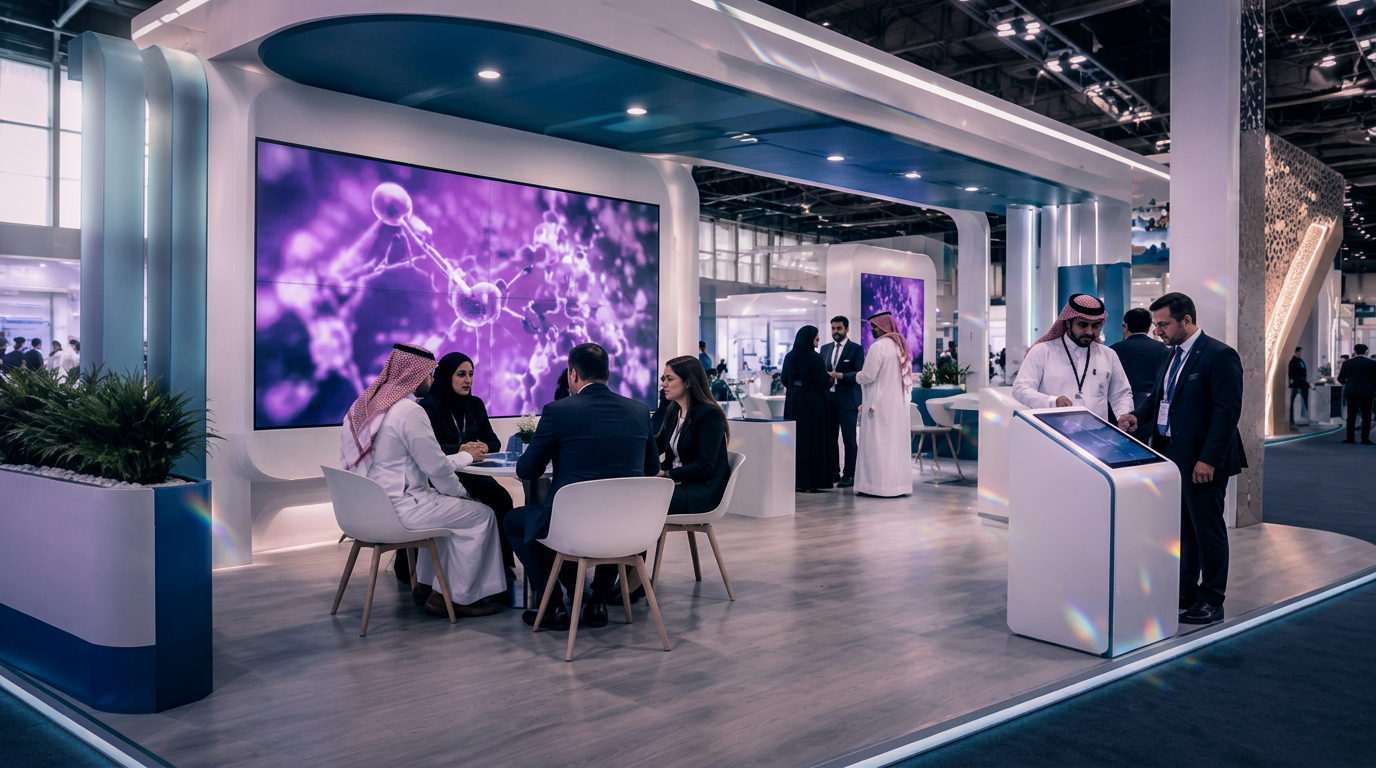
In-person touchpoints remain disproportionately valuable in KSA for relationship-building and scientific exchange. The Saudi medical congress calendar is dense, with major events hosted by specialty societies, private hospital groups, and the MOH throughout the year. Sponsoring or exhibiting at these events — with well-designed experiential booths, satellite symposia, and hands-on demonstration stations — creates engagement depth that digital channels cannot replicate.
Spectra Solutions MEA designs congress and event experiences specifically for the KSA and GCC market, with bilingual environments, culturally resonant design, and measurable engagement tracking built in from the outset.
5. Measurement and Closed-Loop Feedback
An omnichannel program that cannot demonstrate its impact will not survive budget cycles. Brands should define HCP engagement metrics — reach, frequency, content completion rates, meeting conversion rates, and ultimately prescribing behavior shifts — and build reporting loops that feed insight back into the channel mix. Attribution in omnichannel environments is complex, but even a basic dashboard tracking engagement by segment and channel provides the evidence base needed for continued investment.
Cultural and Compliance Considerations?
Operating effectively in Saudi Arabia requires more than translating content into Arabic. Engagement programs must reflect the values and communication preferences of Saudi HCPs: respect for hierarchy, appreciation for scientific rigor, and sensitivity to gender dynamics in mixed professional settings. Bilingual materials — Arabic and English — are a baseline expectation for any serious market entrant.
From a regulatory standpoint, all promotional activities for prescription products must adhere to SFDA's guidelines on advertising and promotion. Company interactions with healthcare professionals must comply with industry codes, and hospitality or gift standards are strictly regulated. Brands new to KSA should conduct a formal compliance review of their planned engagement activities before launch.
Building Your Program: Where to Start?
For brands at the beginning of their HCP engagement journey in KSA, or those seeking to upgrade existing approaches, the priority actions are:
Audit your current channel mix and identify gaps — where are you absent, and where are competitors visibly active? Map the HCP microsegments that matter most for your brand in KSA, and build PDPL-compliant data infrastructure to support them. Identify two or three high-leverage events or society partnerships for the next 12 months. Pilot a digital-first engagement sequence with a defined HCP segment before scaling.
The Saudi healthcare market rewards brands that engage intelligently, consistently, and with genuine scientific value. Omnichannel is the mechanism — but physician trust is the destination.
Ready to build your HCP engagement program for Saudi Arabia? Contact us at service@spectra-mea.com to discuss how Spectra Solutions MEA can design and execute an engagement strategy tailored to your brand and target audience.
Have a question we did not cover?
Talk to our team about HCP engagement, experiential and digital strategy across the GCC.
Ask our team